Oticon Reveal vs Phonak Audéo EON : Which Hearing Aid Should You Choose?

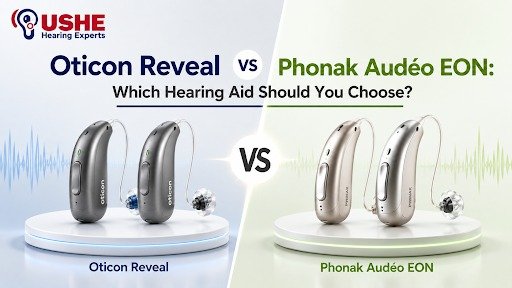
Both launched in 2026, and they’re the newest flagships from two of the biggest names in hearing. Comparing Oticon Reveal vs Phonak Audéo EON means comparing genuinely different engineering philosophies, not two versions of the same idea.
One clarification first, because it trips people up. “Audéo EON” usually means the Audéo EON R, the standard rechargeable model. Phonak also makes the Audéo EON Sphere, a higher tier with different speech processing. This comparison covers the EON R. If someone quotes you Sphere features at an EON R price, question it.
Summary
Oticon Reveal introduces a Dual AI system, a dedicated Speech AI and a separate Context AI running simultaneously plus up to 25 dB more available gain than three top competitors, according to Oticon’s own testing. Phonak Audéo EON R runs AutoSense OS AI 8.0 with WindBlock 2.0, up to 38 hours of battery, Auracast broadcast audio, and compatibility with Roger wireless microphones.
Reveal focuses on balancing speech against surrounding sound. EON R focuses on connectivity breadth and all-day practicality. Both are rechargeable RIC designs with CROS options for single-sided deafness.
Key Takeaways
- Oticon Reveal runs two AI systems at once: Speech AI and Context AI
- Phonak Audéo EON R runs AutoSense OS AI 8.0 with WindBlock 2.0
- Phonak states up to 38 hours battery; Oticon describes all-day rechargeable power
- EON R supports Auracast broadcast audio and Roger wireless microphones
- Reveal offers up to 25 dB more available gain, affecting fitting freedom
- Both offer a CROS solution for single-sided deafness
- The wind noise figures are not measured the same way
Table of Contents
Two Different Ideas About Sound
Oticon has historically kept your entire sound environment open, reasoning that your brain works better with a complete picture. Phonak has leaned toward automatic scene detection identifying your situation and optimizing for it without you doing anything.
Reveal pushes Oticon’s philosophy further. Speech AI handles the voice you’re following; Context AI handles the room, the footsteps, the car on your left. Both run continuously. The aim is clarity without flattening everything else into mush.
EON R refines Phonak’s. AutoSense OS AI 8.0 classifies your environment and adjusts automatically, with a feature set built around removing friction connectivity that just works, easier cleaning, long battery.
Neither is wrong. They suit different people.
Oticon Reveal: Clarity Without Flattening
Dual AI is the headline, but the specification I’d point a patient toward is the gain figure. Oticon reports up to 25 dB more available gain than three top competitors, achieved through improved feedback prevention.
That sounds abstract until you’ve been in a fitting room. Feedback from that whistle is why many hearing aids get fitted more conservatively than the audiogram calls for. Better feedback control lets your audiologist deliver the amplification you actually need, with a more open fitting. If your current aids whistle when you hug someone or pull on a hat, this is the difference you’d feel.
Reveal also uses 4D Sensor technology, connects directly to iPhone, iPad and Android, and Oticon reports 53% better streaming stability with up to 32% greater range than Oticon Intent. An Oticon CROS RE covers single-sided deafness.
Best for: People who find speech-focused hearing aids sound artificial, anyone whose fittings have been limited by feedback, and wearers who want the full sound scene without losing conversation.
Phonak Audéo EON R: Built Around Your Day
EON R’s strength is breadth. Made for All connectivity pairs it with iPhone, Android and virtually any Bluetooth device Phonak has led on Android compatibility for years, which matters more than people expect in a mixed-device household.
Auracast broadcast audio is the feature I’d flag hardest. Participating theaters, gyms and museums send sound straight to your hearing aids; you join by scanning a QR code in the myPhonak app. If you attend live performances or travel often, that’s a real quality-of-life gain.
Then there’s Roger. Phonak’s wireless microphones transmit speech directly to EON hearing aids via RogerDirect. For anyone in frequent meetings or lectures, Roger does what no on-board processing can match: it puts a microphone next to the person talking.
Battery runs up to 38 hours, EasyGuard domes seal against earwax, and CROS EON R covers single-sided deafness. It fits mild to profound hearing loss.
Best for: People in meetings and lecture halls, heavy streamers, Android users, Auracast venue-goers, and anyone who wants a long battery with minimal fuss.
Oticon Reveal vs Phonak Audéo EON Hearing Aid Comparison: Features & Performance
|
Oticon Reveal |
Phonak Audéo EON R |
|
|---|---|---|
|
Core system |
Dual AI (Speech + Context) |
AutoSense OS AI 8.0 |
|
Wind handling |
Wind & Handling Stabilizer 2.0, up to 40 dB |
WindBlock 2.0, up to 50 dB |
|
Battery |
All-day rechargeable |
Up to 38 hours |
|
Auracast |
Not specified |
Yes |
|
Wireless mics |
— |
Roger via RogerDirect |
|
Sensors |
4D Sensor technology |
Automatic scene classification |
|
Available gain |
Up to 25 dB more than 3 competitors |
Not specified |
|
Wax protection |
Standard |
EasyGuard sealed domes |
|
CROS option |
Oticon CROS RE |
CROS EON R |
|
Style |
Rechargeable miniRITE |
Rechargeable RIC |
Read the Wind Numbers Carefully
Here’s something most comparison pages get wrong.
Both advertise wind noise reduction. Oticon says up to 40 dB. Phonak says up to 50 dB. Phonak looks like the clear winner except the numbers aren’t measuring the same thing.
Phonak’s 50 dB compares WindBlock 2.0 on against WindBlock 2.0 off. Oticon’s 40 dB covers wind and handling noise, and their 10 dB improvement is measured against their own first-generation system.
Different baselines, different scope. You can’t subtract one from the other and conclude Phonak wins by 10 dB. Handling noise from the scrape when you adjust your glasses or pull up a hood is a real daily irritation Oticon is explicitly addressing.
The same caution applies to both brands. Every headline figure here comes from manufacturer research, not independent testing. That’s normal in this industry, but “up to” is doing heavy lifting.
Which One Should You Choose?
Choose Oticon Reveal if speech-focused hearing aids have ever sounded tunnel-like to you, if feedback has limited your fittings, or if you want conversation clarity without losing your sense of the room.
Choose Phonak Audéo EON R if you spend real time in meetings or lectures where a Roger microphone would help, if Auracast venues are part of your life, if you’re an Android user, or if 38 hours of battery matters more than the last increment of processing.
If you’re regularly in loud, crowded rooms and speech-in-noise is your single biggest struggle, also ask your audiologist about the Audéo EON Sphere; it’s the higher tier built specifically for that.
Conclusion
There’s no universal winner between Oticon Reveal and Phonak Audéo EON R. The right choice depends on your hearing loss, speech-in-noise performance and daily listening needs. Oticon Reveal focuses on clear speech, natural sound awareness and flexible fitting. Phonak Audéo EON R is designed for connected, active lifestyles, offering broad connectivity, Roger support and long-lasting rechargeable power.
At USA Hearing Experts, explore prescription hearing aids from Oticon, Phonak, Signia, Starkey, ReSound and Widex at competitive prices, with free programming, free U.S. shipping and a 30-day return window. Send us your hearing test report for help choosing the right model and technology level. Call (469) 432-4011 or visit usahearingexperts.com.
Frequently Asked Questions (FAQs)
Oticon Reveal runs a Dual AI system, with separate Speech AI and Context AI operating at once to balance conversation against surrounding sound. Phonak Audéo EON R uses AutoSense OS AI 8.0 to classify your environment and adjust automatically, with a feature set built around connectivity, battery life and easy maintenance.
Phonak states up to 38 hours for the Audéo EON R. Oticon describes Reveal as offering all-day rechargeable power without publishing a comparable hourly figure. Real runtime for either depends on your hearing loss, how much you stream, which features are active, and battery age.
Phonak Audéo EON R supports Roger wireless microphones through RogerDirect, transmitting speech straight to the hearing aids. That's a meaningful advantage in meetings, lectures and classrooms. Roger is Phonak's own system and is not part of the Oticon Reveal platform.
Both handle noise well by different methods. If speech in loud crowds is your hardest situation, ask about the Phonak Audéo EON Sphere, which sits above the EON R and is built specifically for that. Your speech-in-noise test results should guide this.
Yes. A current audiogram, including speech testing in noise, determines which device and technology level suits your hearing loss. Sudden hearing loss in one ear, ear pain, drainage or dizziness needs prompt medical attention rather than a hearing aid appointment.
Ready to Find Your Perfect Oticon with USA Hearing Experts?
We offer a free comprehensive hearing test, a trial of both Oticon Own AND Oticon Zeal, real-world testing guidance, an honest comparison, flexible financing, and expert audiologists.