Are Hearing Aid Glasses Safe for Your Ears What to Know Before You Try Them

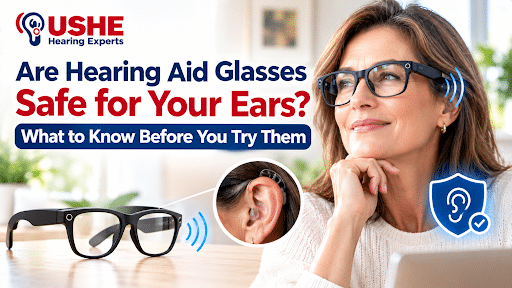
Yes, FDA-cleared hearing aid glasses are safe for your ears. They’re regulated medical devices with built-in output limits designed to stop them amplifying sound to a harmful level.
The longer answer matters, because the real risks aren’t in the glasses. They’re in what you skip when you buy a pair without seeing a professional and in the unregulated amplifier glasses sold alongside the genuine ones.
Summary
FDA-cleared hearing aid glasses, like Nuance Audio, are regulated over-the-counter hearing aids cleared for adults with perceived mild to moderate hearing loss. They include output limiters that cap how loud they can get. The genuine risks are indirect: buying an unregulated amplifier instead, self-assessing your hearing loss wrongly, and skipping the ear examination that catches wax, infection and conditions needing medical attention.
Key Takeaways
- FDA-cleared hearing aid glasses include legally required output limiters
- They’re cleared for perceived mild to moderate hearing loss in adults only
- PSAPs and amplifier glasses are not hearing aids and aren’t held to the same standard
- Nuance Audio uses four preset profiles rather than a test tuned to your ears
- Battery life runs around 6 to 8 hours, not a full day
- No ear examination means wax, infection and red-flag symptoms go unnoticed
- A hearing test confirms whether your loss is in the over-the-counter range at all
Table of Contents
Are FDA-Cleared Hearing Aid Glasses Safe?
Yes, and here’s why that’s a confident answer rather than a hedge.
When the FDA created the over-the-counter hearing aid category in the United States in 2022, it set special controls every cleared device must meet. The most important for safety is an output limit: the device cannot exceed a maximum sound pressure level, even if something goes wrong internally.
Nuance Audio glasses, from EssilorLuxottica, received US FDA clearance in February 2025 under those rules. A peer-reviewed study of adults with age-related hearing loss found mean gains of 10 to 11 dB, with the largest improvements at 4000 to 6000 Hz where speech clarity lives. The researchers noted that moderate amplification of this kind improves communication without over-amplifying environmental sounds or raising the risk of discomfort.
So the hardware is safe. The question is what surrounds it.
What Are the Real Risks?
Four risks matter, and none of them is the amplification itself. They’re about what surrounds the purchase.
1. Buying an Amplifier Instead of a Hearing Aid
The biggest risk, and the easiest to get wrong.
Personal Sound Amplification Products (PSAPs) look similar, often cost less, and sit alongside genuine OTC hearing aids in the same listings. But they aren’t hearing aids. The FDA doesn’t regulate them as medical devices, and they needn’t meet the same output limits. The FDA has warned directly that choosing a PSAP as a hearing aid substitute can lead to more damage to your hearing.
Check that any listing says FDA-cleared over-the-counter hearing aid. If it says “sound amplifier” or avoids the phrase, it isn’t the same product.
2. Guessing Your Own Hearing Loss
OTC clearance covers perceived mild to moderate hearing loss. That word matters when you’re assessing yourself.
Age-related hearing loss usually starts in the high frequencies, exactly where people underestimate it. Someone who believes their loss is mild may sit in the moderately severe range, where glasses cannot deliver enough amplification. The outcome isn’t ear damage, it’s spending money on something that won’t work, then concluding hearing aids don’t help you.
3. Nobody Examines Your Ears
This is the one that genuinely concerns audiologists.
A professional hearing test includes looking inside your ears how wax blockage, perforated eardrums, fluid and infections get spotted, all treatable and none helped by amplification.
It’s also how red flags get caught. Hearing loss in one ear only, sudden loss, ringing in one ear, dizziness or drainage can signal conditions needing medical attention. A preset profile in a pair of glasses amplifies straight past all of them.
4. Presets Aren’t a Fitting
Worth knowing about Nuance Audio specifically: its FDA submission confirms the software does not use a self-fitting strategy. You pick from four preconfigured profiles A, B, C or D rather than taking a test that tunes the glasses to your audiogram. That’s not unsafe, but it isn’t personalised either, and two people on the same preset can have very different ears.
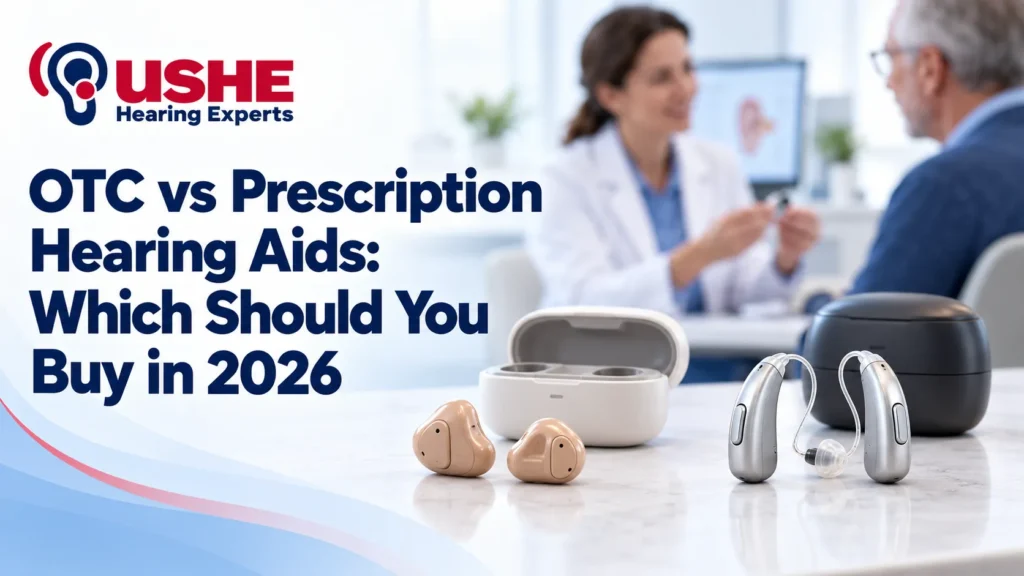
Hearing Aid Glasses vs Prescription Hearing Aids
The two differ most on fitting, hearing loss range and wear time. Output safety limits apply to both.
|
FDA-cleared hearing glasses |
Prescription hearing aids |
|
|---|---|---|
|
Regulatory status |
OTC hearing aid |
Prescription medical device |
|
Hearing loss range |
Perceived mild to moderate |
Mild to profound |
|
Fitting |
Preset profiles |
Programmed to your audiogram |
|
Ear examination |
None |
Included |
|
Output safety limits |
Yes |
Yes |
|
Battery life |
Around 6–8 hours |
Full day |
|
Bluetooth streaming |
Not on current models |
Standard on most |
|
Aftercare |
App-based |
Ongoing professional support |
Who Should Avoid Hearing Aid Glasses?
Hearing aid glasses are not suitable for everyone with hearing difficulty. Skip them entirely and see a professional if you have any of the following:
- Hearing loss in one ear only, or noticeably worse on one side
- Sudden hearing loss of any degree
- Ear pain, drainage or discharge
- Dizziness or balance problems
- Ringing in only one ear
- A history of ear surgery or perforated eardrum
None of these are suited to self-treatment with amplification, and some need prompt medical attention.
Also reconsider if your hearing loss is beyond moderate that range needs a RIC or BTE hearing aid or if you don’t wear glasses anyway, or need support for more than eight hours a day.
What to Do Before You Try Them
Three steps, in this order, save most people money and prevent common mistakes.
Get a hearing test first. It tells you whether your loss is actually in the OTC range, or whether you need something glasses cannot provide.
Have your ears examined. Wax alone causes a surprising amount of hearing difficulty, and removing it is quicker and cheaper than any device.
Compare against a properly fitted alternative. If your test shows your loss sits beyond the over-the-counter range, a prescription hearing aid programmed to your audiogram will do things glasses cannot increase amplification, a fitting matched to your ears, and support as your hearing changes.
Conclusion
Hearing aid glasses are safe in the way that matters most: the FDA-cleared ones are regulated medical devices with legally required output limits, and the clinical evidence shows real, measurable improvement for adults with mild to moderate hearing loss. The risks worth worrying about sit around the product rather than inside it buying an unregulated amplifier that looks identical, misjudging your own hearing loss and ending up with a device that was never going to help, and above all skipping the ear examination where wax, infection and the warning signs of treatable conditions get caught.
None of that makes hearing glasses a bad idea. It makes a hearing test a sensible first step rather than an optional one, because once you know what your audiogram says, choosing between glasses and a prescription device stops being a guess.
Get Your Ears Checked First
Before spending on any hearing device, find out what you’re dealing with. A full hearing evaluation at USA Hearing Experts includes an ear examination and speech testing in noise, not just tones. If your loss turns out to be mild and an over-the-counter option suits you, we’ll tell you and if it doesn’t, you’ll know before you spend.
Call (469) 432-4011 or shop hearing aids to compare options across the United States.
Frequently Asked Questions (FAQs)
FDA-cleared hearing aid glasses include output limiters that cap maximum sound levels, so they should not damage your hearing when used as directed. Unregulated personal sound amplifiers are a different matter; the FDA has warned that using one as a hearing aid substitute can cause further hearing damage.
Nuance Audio glasses received FDA clearance in February 2025 as an over-the-counter hearing aid. Note that "cleared" and "approved" are different pathways clearance means the device met the requirements of an existing category, which for OTC hearing aids includes mandatory output safety limits.
Anyone with hearing loss in one ear only, sudden hearing loss, ear pain, drainage, dizziness, ringing in one ear, or a history of ear surgery should see a professional rather than self-treating. These can signal conditions that need medical attention, and amplification will not address them.
For mild to moderate hearing loss, clinical testing shows meaningful improvement mean gains of 10 to 11 dB in one peer-reviewed study. But they use preset profiles rather than programming to your audiogram, run 6 to 8 hours rather than all day, and don't currently support Bluetooth streaming.
Yes. A professional test confirms whether your hearing loss is genuinely in the over-the-counter range, and an ear examination catches wax, infection or other treatable issues that amplification won't fix. Self-assessment cannot look inside your ear.
Ready to Find Your Perfect Oticon with USA Hearing Experts?
We offer a free comprehensive hearing test, a trial of both Oticon Own AND Oticon Zeal, real-world testing guidance, an honest comparison, flexible financing, and expert audiologists.