Where to Buy Hearing Aids Online: Best Options for 2026

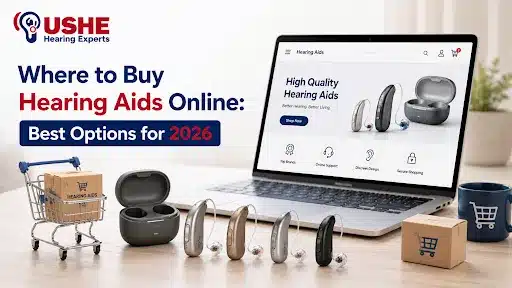
You can buy hearing aids online now. What most people don’t realize is that “online” covers four fairly different routes, and they don’t all give you the same device, the same price, or the same support afterward.
That matters more than the brand you pick. I’ve talked to people who bought a perfectly good hearing aid online, never got it programmed to their hearing loss, and concluded hearing aids just don’t work. The device wasn’t the problem. The buying route was.
So let’s walk through your options.
Summary
There are four ways to buy hearing aids online in 2026: over-the-counter devices you set up yourself, prescription hearing aids from specialist online retailers, manufacturer direct-to-consumer programs, and general marketplaces. The right one depends on your degree of hearing loss and how much support you want.
Prices at USA Hearing Experts run from around $699 for older BTE models to over $4,000 for premium rechargeable pairs, with most popular models between $1,299 and $3,499. The biggest thing to check isn’t the price, it’s whether the listed figure covers one ear or two.
Key Takeaways
- OTC hearing aids are only for adults 18+ with perceived mild to moderate hearing loss
- Prescription hearing aids cover the full range, including severe and profound loss
- Specialist online retailers usually offer the widest selection at discounted prices
- Online prices are often listed per ear, not per pair always check
- Expect roughly $699 to $4,700 depending on brand, technology level and ear count
- A return window and remote programming matter more than the headline discount
- If you don’t have a recent hearing test, get one before buying anything
Table of Contents
First: OTC or Prescription?
This is the fork in the road, and worth getting right before you compare a single price.
Over-the-counter hearing aids became legally available in the US in late 2022. They’re sold directly to consumers without a prescription or professional fitting. The catch is who they’re for: adults 18 and over with what they perceive as mild to moderate hearing loss. Not children, and not severe or profound loss.
Prescription hearing aids can be appropriate for a wider range of hearing losses, including severe hearing loss. They can be professionally programmed to your hearing needs, while many models also allow additional adjustments through an app.
Here’s the bit most articles skip: plenty of people don’t know which category they fall into. “Mild to moderate” is a measurement, not a feeling. People who think their loss is mild often turn out to have moderate-to-severe loss in the higher frequencies exactly where speech clarity lives. That’s why a hearing test comes first, even if you fully intend to buy online afterward.
The Four Ways to Buy Hearing Aids Online
1. Over-the-Counter Direct-to-Consumer
You order, it arrives, you set it up yourself through an app. Fast and usually cheapest.
Best for: Adults with confirmed mild to moderate loss who are comfortable with technology.
Watch out for: No professional programming. If the self-fitting doesn’t sound right, you’re troubleshooting alone.
2. Specialist Online Hearing Aid Retailers
These sell prescription-grade devices from the major manufacturers below clinic rates, usually with remote audiologist support. You send your hearing test report; they program the device to it.
Best for: People who already have an audiogram and want premium technology without clinic markup.
Watch out for: Selection and support vary between retailers. Check the return policy before the price.
3. Manufacturer Direct
Some brands now sell straight to consumers. Genuine article, full warranty, usually at list price rather than a discount.
Best for: Buyers who know exactly which model they want.
4. General Online Marketplaces
Broad selection, competitive prices, weakest safeguards of the four. Counterfeits and grey-market stock are a real issue here, and a hearing aid without a valid warranty is an expensive paperweight the moment something fails.
Best for: Accessories, batteries, domes and chargers rather than the hearing aids themselves.
What Hearing Aids Actually Cost Online
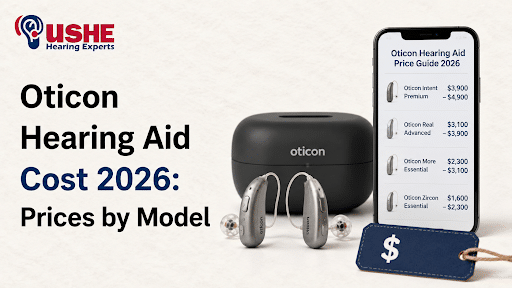
Here’s current pricing from our own catalog, so you can see the real spread rather than a vague “$1,000 to $6,000” range.
|
Model |
Price range |
|---|---|
|
Oticon Chilli SP 9 BTE |
$699 – $1,398 |
|
Oticon Dynamo SP 8 BTE |
$825 – $1,649 |
|
Oticon Intent 4 miniRITE |
$1,299 – $2,199 |
|
Oticon Intent 3 miniRITE |
$1,399 – $2,499 |
|
Oticon Alta 1 Pro Mini BTE |
$1,480 – $2,960 |
|
Oticon Intent 2 miniRITE |
$1,699 – $2,999 |
|
Signia Styletto 7AX SLIM-RIC Kit |
$1,699 – $3,049 |
|
Oticon Intent 1 miniRITE |
$1,899 – $3,499 |
|
Starkey Evolv AI 2400 RIC R |
$2,222 – $4,444 |
How to Read Those Ranges
This is the single most useful thing in this article, so here it is plainly.
Look at the Starkey Evolv AI: $2,222 to $4,444. That top figure is exactly double the bottom one. Same with the Oticon Chilli at $699 to $1,398. The low number is one hearing aid. The high number is a pair on the product page itself, the Style selector reads Left, Right or Both.
Most people with hearing loss have it in both ears and need two devices. So when comparing an online price against a clinic quote, compare pairs to pairs. A $1,299 hearing aid and a $2,199 pair are the same product, and mixing those up is how people convince themselves they’ve found a bargain that doesn’t exist.
Some models discount the pair Oticon Intent 1 is $1,899 for one but $3,499 for two rather than $3,798. Worth checking on whichever model you’re considering.
What to Check Before You Click Buy
Price is the easy part. These four things matter more.
A real return window. You need time to wear them in your actual life: your kitchen, your workplace, the restaurant you always struggle in. A few days isn’t enough. Two to four weeks is reasonable.
Programming. Prescription hearing aids must be set to your audiogram. Ask how that happens: do you send your test results, and can adjustments be made remotely afterward?
Warranty and authorized-dealer status. Manufacturer warranties usually only apply through authorized sellers the main reason to be cautious with marketplace listings.
Ongoing support. Hearing aids need occasional adjusting, cleaning and re-tuning as your hearing changes. Find out what happens in month eight, not just week one.
When Buying Online Isn't the Right Call
Be straight with yourself here. If you have significant dexterity problems, severe or profound hearing loss, ear pain, drainage, or hearing that dropped suddenly in one ear or if you’ve never had a hearing test at all, start with a professional rather than a checkout page. Sudden hearing loss in one ear needs prompt medical attention, not a hearing aid.
Buying online works well when you know what you need. It works badly as a way of avoiding finding out.
Conclusion
Buying hearing aids online in 2026 can be a smart option, with real savings compared with traditional clinic pricing. But the retailer matters just as much as the device, especially when it comes to programming and ongoing support.
At USA Hearing Experts, you can compare prescription hearing aids from Oticon, Signia, Starkey, ReSound, and Widex at below-clinic prices, with audiologists available to program and support your devices. Send us your hearing test report, call (469) 432-4011, or visit usahearingexperts.com to compare models and prices.
If you don’t have a recent hearing test, consider getting one before buying. It can help you understand the type and degree of your hearing loss and choose a device more confidently.
Frequently Asked Questions (FAQs)
Yes. Over-the-counter hearing aids can be bought directly by adults 18 and over with perceived mild to moderate hearing loss. Prescription hearing aids can also be purchased online through retailers who program them to your audiogram. Both routes are legal; they differ in who they're suitable for and how they're fitted.
Prices vary widely by brand and technology level. Current listings run from around $699 for older BTE models up to roughly $4,700 for premium rechargeable pairs, with popular current models between $1,299 and $3,499. Remember that lower figures in a range usually reflect a single device rather than a pair.
OTC hearing aids do not require a hearing test or prescription under federal law. A hearing test is strongly recommended before buying, however, because it helps determine the type and degree of hearing loss. Prescription hearing aids are intended for a wider range of hearing loss and are professionally programmed to the user's needs, but state requirements can vary.
Usually, yes. Online retailers carry lower overheads than physical clinics, and the savings are often substantial. What you trade is in-person appointments. If your hearing loss is straightforward and you're comfortable with remote support, that trade often makes sense.
Check they're an authorized dealer for the brands they sell, since manufacturer warranties typically depend on it. Look for a clear return window, a published refund policy, a real phone number, and access to qualified staff for programming and follow-up adjustments.
Ready to Find Your Perfect Oticon with USA Hearing Experts?
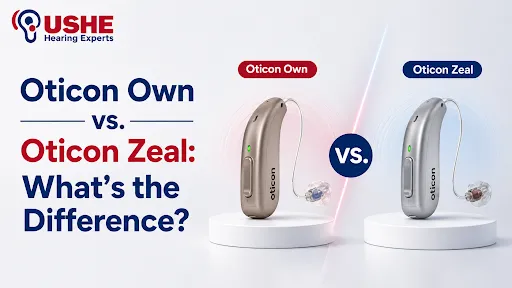
We offer a free comprehensive hearing test, a trial of both Oticon Own AND Oticon Zeal, real-world testing guidance, an honest comparison, flexible financing, and expert audiologists.