
AirPods Pro vs Prescription Hearing Aids: Which Is Right for Your Hearing Loss?

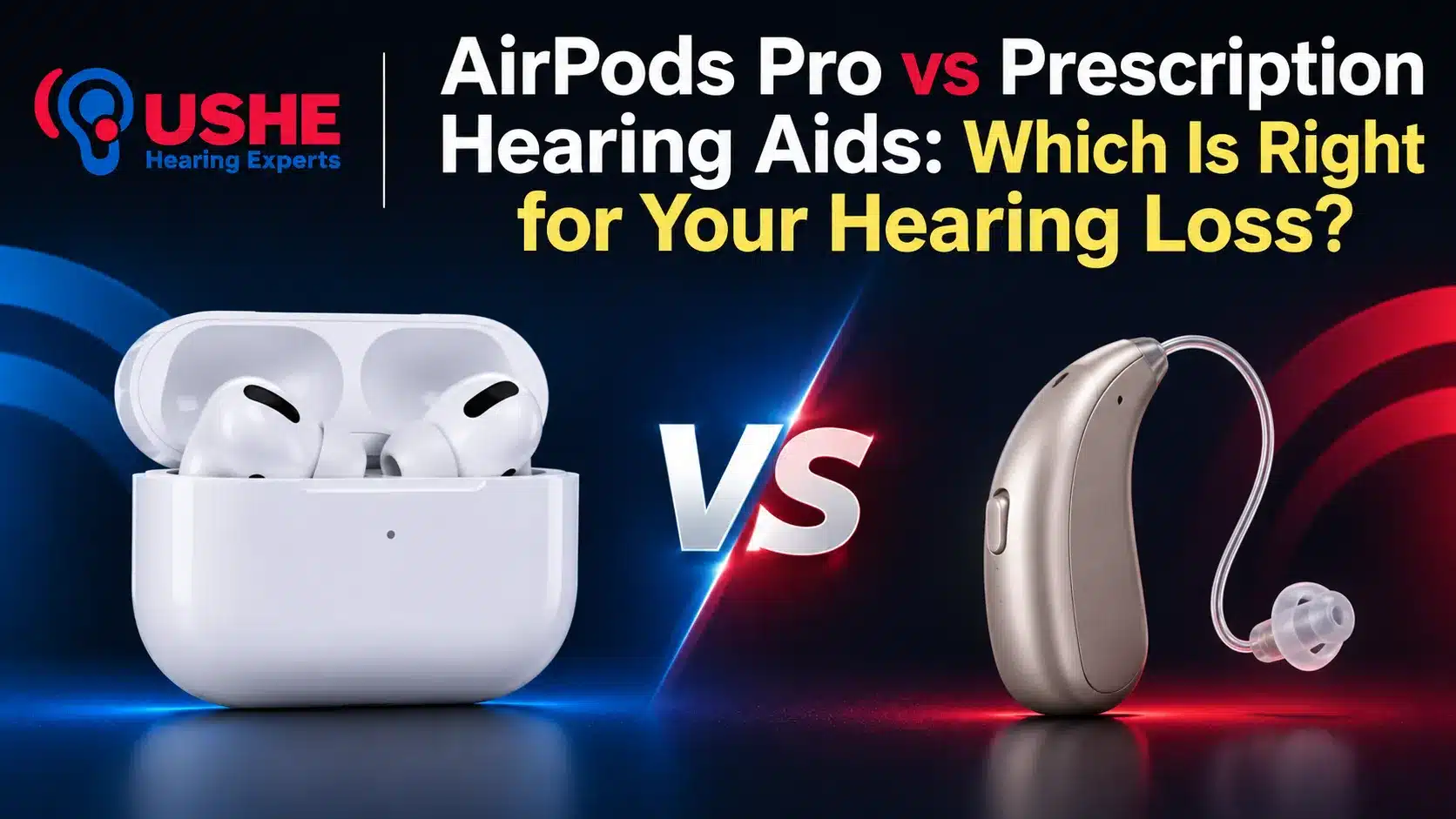
AirPods Pro 2 and 3 include an FDA-authorized Hearing Aid feature for adults 18 and older with perceived mild to moderate hearing loss. Prescription hearing aids are programmed by a hearing professional and are the better route if your loss may be more advanced. If you are unsure which describes you, start with a hearing test.
Can the earbuds already in your pocket also work as hearing aids? For some adults, yes. It is not the right option for everyone, and the gap shows up fastest in noisy rooms, in more advanced loss, and when you want ongoing professional adjustment. This guide compares the two, and for the wider backdrop, read our guide to OTC hearing aids.
Summary
The AirPods Pro Hearing Aid feature is an over-the-counter option for adults with perceived mild to moderate loss. Prescription hearing aids are professionally programmed and intended for any degree of loss. A hearing test is the best first step either way.
Key Takeaways
- The AirPods Pro Hearing Aid feature was FDA authorized on September 12, 2024, for adults 18 and older with perceived mild to moderate loss.
- It needs AirPods Pro 2 or 3 and an iPhone or iPad.
- Prescription hearing aids are professionally programmed and can suit any degree of loss.
- A hearing test helps you choose, and some symptoms call for a doctor first.
Are AirPods Pro Really Hearing Aids?
The Hearing Aid feature is software. The FDA authorized it on September 12, 2024 as the first over-the-counter hearing aid software, so it needs no prescription, exam or audiologist visit.
Plain AirPods are still earbuds; the hearing aid function is switched on through setup.
Which AirPods and devices work?
Apple says the feature needs AirPods Pro 2 or AirPods Pro 3 with the latest firmware, paired with an iPhone or iPad running the latest software. Apple’s availability page lists the United States among supported countries.
Who is it designed for?
The FDA and Apple describe it for adults 18 or older with perceived mild to moderate loss, not severe or profound loss.
How Does the AirPods Hearing Test and Setup Work?
Setup starts with a hearing test taken on your iPhone or iPad using the AirPods, or with an audiogram from a hearing professional that you add. You begin in Settings under Hearing Health, then Hearing Assistance. Depending on your results, Apple may prompt you to turn on Media Assist instead of Hearing Aid.
Per Apple’s support page, the feature amplifies surrounding sound only in Transparency mode, and the AirPods must be charged for it to work properly. Conversation Boost works best one-on-one when the speaker is right in front of you.
The FDA reported that the feature was tested with 118 people with perceived mild to moderate hearing loss. Those who set it up themselves reported perceived benefits similar to those who were professionally fitted.
AirPods Pro vs Prescription Hearing Aids: Side by Side
| Factor | AirPods Pro (Hearing Aid feature) | Prescription hearing aids |
|---|---|---|
| Intended loss | Perceived mild to moderate | Any degree, including severe and profound |
| Age | 18 and older | Adults and children (under 18 needs a prescription and a doctor visit) |
| Who sets it up | You, using the in-device test or an uploaded audiogram | A hearing professional programs it to your loss |
| Works with | Compatible Apple devices | Varies by model; many stream over Bluetooth |
| Built for | Everyday earbud use plus a hearing aid mode | All-day, purpose-built wear |
| Styles | One earbud design | Behind-the-ear, receiver-in-canal, in-the-ear and more |
| Adjustments | Self-adjusted in settings | Fine-tuning with professional guidance |
Who Might Prefer AirPods Pro?
With a perceived mild to moderate loss and an iPhone, the feature can be appealing. One device for music, calls and hearing support can feel less like a medical purchase.
It can make sense when:
- You already own compatible AirPods Pro and an up-to-date iPhone or iPad
- Your trouble is mainly in certain situations, like quiet conversations or TV
Be cautious if you struggle most in noise or hear worse in one ear. Those can point past what an OTC feature is meant to handle.
When Do Prescription Hearing Aids Make More Sense?
If your loss is beyond mild to moderate, or you want a professional to program and adjust the devices, prescription hearing aids are the better fit. They are built for long hours of wear and come in styles from nearly invisible to power behind-the-ear models. Our guide to the levels of hearing loss shows how loss maps to device choices.
The Oticon Intent 1 rechargeable RIC is one example we carry. Its product page lists it at $1,899 to $3,499 and says it connects to your smart devices over Bluetooth. The page doesn’t say whether that price is per ear or per pair, so confirm with us before you order.
If you use an iPhone, pairing a dedicated hearing aid is not complicated. Our walkthrough shows how to connect Oticon hearing aids to iPhone.
Is It Cheaper to Use AirPods Pro as Hearing Aids?
It can be if you already own compatible AirPods Pro, since the feature is software on a device you may have. We are not quoting Apple’s price here, so check apple.com for the current figure.
Prescription hearing aids usually cost more up front but are purpose-built and professionally programmed. For a sense of range, the Oticon Reveal 2 is priced from $1,449 to $2,949 depending on configuration. Apple isn’t the only tech brand with an OTC feature, and we cover another in Can Meta Glasses Replace Hearing Aids?
How Do You Decide?
| If this sounds like you | Consider |
|---|---|
| Compatible AirPods Pro, an iPhone, and mild trouble following conversation | Trying the Hearing Aid setup, ideally after a professional test |
| You have never had a hearing test | A professional hearing test first |
| Your loss may be beyond mild to moderate | A prescription hearing aid with professional fitting |
| Ear pain, dizziness or hearing change in one ear | A doctor visit before any device |
You can start with one and switch later, and a hearing test you take now stays useful for either path.
Should You Get a Hearing Test Before Choosing?
Yes. A professional evaluation tells you the type and degree of your loss, whether anything needs a doctor’s attention, and which category fits. The FDA advises seeing a doctor first for ear pain, blood, pus or fluid from the ear, sudden or fluctuating hearing change, dizziness, or ringing in only one ear.
Bring any recent audiogram and a list of the hardest situations. When you are ready to compare models, see our picks of the best hearing aids in the USA for 2026.
Conclusion
AirPods Pro can be a reasonable first step for an adult with mild to moderate loss who already has the right Apple devices. Prescription hearing aids remain the stronger choice when your loss is more advanced, when you want all-day wear, or when you want a professional to fine-tune the sound. Pick for your hearing, your lifestyle and the support you want, not for brand familiarity, and get a hearing test so you know where you stand.
Not Sure Which Route Fits?
Call (469) 432-4011 or email support@usahearingexperts.com with your audiogram, and our experts will help you compare options. You can also book an online consultation with our team.
Frequently Asked Questions
Are AirPods Pro FDA approved as hearing aids?
The FDA authorized the Hearing Aid feature on September 12, 2024, as over-the-counter hearing aid software. It is intended for adults 18 and older with perceived mild to moderate hearing loss.
Which AirPods have the hearing aid feature?
Apple lists AirPods Pro 2 and AirPods Pro 3 with the latest firmware, used with an iPhone or iPad running the latest software.
Can AirPods Pro treat severe hearing loss?
No. The feature is meant for perceived mild to moderate loss, and OTC hearing aids in general are not intended for severe or profound loss. If your loss may be more advanced, see a hearing professional.
Do AirPods Pro replace prescription hearing aids?
They offer a different option aimed at mild to moderate loss. Prescription hearing aids are professionally programmed and can suit any degree of loss.
Can I use the AirPods Pro hearing aid feature with Android?
Apple’s setup requires an iPhone or iPad, so the feature depends on Apple hardware. Android users can look at dedicated OTC or prescription hearing aids instead.