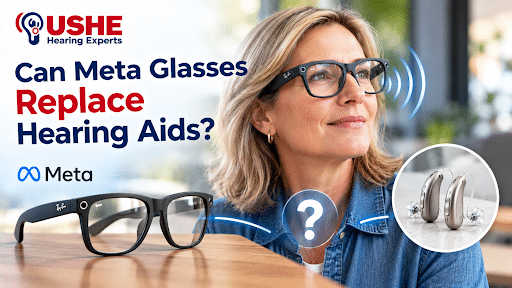
Can Meta Glasses Replace Hearing Aids? What the FDA Feature Does

Most coverage of this gets it wrong in one direction or the other.
It isn’t hype and it isn’t a gimmick. At Meta Connect on 23 September 2026, Meta announced Hearing Enhancement, a genuinely FDA-cleared over-the-counter hearing aid feature that turns supported AI glasses into a hearing device for $149.99.
It also isn’t a replacement for hearing aids for most people who need them. Both are true, and the difference comes down to one thing: how much hearing you’ve lost.
Summary
Meta’s Hearing Enhancement is FDA-cleared software for adults 18 and over with perceived mild to moderate hearing loss. You take a guided hearing test in the app, and the glasses tune amplification to your results no clinic, no prescription. It costs $149.99 as a one-off unlock (HSA/FSA eligible) or comes with a Meta One subscription, after a 30-day free trial. It arrives on Meta Glasses in the US later in 2026, then Ray-Ban Meta Gen 3 and Ray-Ban Meta Audio.
Key Takeaways
- Meta’s feature is called Hearing Enhancement, announced 23 September 2026
- It’s FDA-cleared under the 2022 over-the-counter hearing aid rule
- Suitable for adults 18+ with perceived mild to moderate hearing loss only
- Costs $149.99 on top of the glasses, with a 30-day free trial
- Two modes: 360 for all-round sound, Focus for the person in front of you
- Rolling out on Meta Glasses first, then Ray-Ban Meta Gen 3 and Ray-Ban Meta Audio
- “FDA-cleared” is narrower than “FDA-approved” the distinction matters
- Independent labs haven’t tested the feature yet
Table of Contents
What Is Meta's Hearing Enhancement Feature?
It’s software, not new hardware. You buy supported Meta AI glasses, pay to unlock the feature, and take a guided hearing test on your phone. The glasses then amplify based on your results.
There are two modes. 360 mode amplifies sound from all directions, useful walking around or at home. Focus mode aims the microphones forward at whoever is across the table, which is what helps in a restaurant.
Meta says its phone-based test performed equivalently to a professional fitting within an acceptable margin during clearance testing the basis on which the FDA cleared it.
This goes beyond Conversation Focus, the earlier speech-boosting feature on Ray-Ban Meta glasses. That was consumer audio. This is a regulated hearing aid.
What Does "FDA-Cleared" Actually Mean?
This is where precision matters, and where a lot of coverage is sloppy.
FDA-cleared is not FDA-approved. Cleared means the software met the requirements of the over-the-counter hearing aid category the FDA created in 2022. It does not mean the glasses were evaluated as a general medical device, and it doesn’t imply clinical superiority.
That same 2022 category already covers Apple’s AirPods Pro hearing aid feature, authorised in September 2024, with Samsung’s Galaxy Buds version arriving late 2026.
So: it’s a legitimate regulated hearing aid within a specific, limited category. It is not a prescription device, and it was never assessed as one.
How Much Do Meta Glasses Cost as a Hearing Aid?
The unlock is $149.99 on top of whichever glasses you buy, HSA and FSA eligible, with a 30-day free trial.
|
Glasses |
Price |
With hearing unlock |
|---|---|---|
|
Meta Glasses (entry) |
$249 |
~$399 |
|
Ray-Ban Meta Audio |
$349 |
~$499 |
|
Ray-Ban Meta (Gen 3) |
$449 |
~$599 |
Being straight about this: at roughly $399 all in, the cheapest Meta route is genuinely inexpensive, and one purchase covers both ears. That’s a fraction of what prescription hearing aids typically cost.
What you’re trading for that saving is the subject of the next two sections.
Who Is It Actually For?
Good candidates: adults with genuinely mild hearing loss who already wear glasses daily, want help in specific situations rather than all day, and are comfortable with a phone-based setup.
There’s a real psychological point too. Plenty of people who’d never wear a hearing aid already wear glasses without a second thought. For someone stuck at that barrier, this may be what gets them hearing better at all.
Poor candidates: anyone with moderate-to-severe or worse loss, anyone who hasn’t had their hearing tested, and anyone who doesn’t wear glasses all day.
What Meta Glasses Can't Do
Six things worth knowing before you spend anything.
They only cover mild to moderate loss. Above that, the amplification simply isn’t there. A receiver-in-canal or behind-the-ear hearing aid delivers far more.
Self-assessed means self-assessed. You decide your hearing is “mild to moderate.” People routinely underestimate their loss, and hearing loss in only one ear can signal something that needs medical attention.
No independent testing yet. HearAdvisor has tested the older Conversation Focus feature but not Hearing Enhancement. Nobody outside Meta has verified performance.
Battery life. Glasses batteries are measured in hours. Hearing aids run all day, and many are rechargeable overnight.
You have to wear glasses. All day, every day, including at home and in bed if you want help then.
No telecoil, no professional fitting, no real-ear verification. Nobody measures what’s actually reaching your eardrum.
Meta Glasses vs Prescription Hearing Aids: Key Differences
|
Features |
Meta Hearing Enhancement |
Prescription hearing aids |
|---|---|---|
|
Hearing loss range |
Mild to moderate |
Mild to profound |
|
Fitting |
Self-test in app |
Audiogram + professional programming |
|
Verification |
None |
Real-ear measurement |
|
All-day wear |
Only while wearing glasses |
Yes |
|
Battery |
Hours |
All day, rechargeable |
|
Telecoil |
No |
Available on many models |
|
Typical cost |
From ~$399 all in, both ears |
Varies widely by technology level |
|
Follow-up support |
App-based |
Audiologist adjustments |
Should You Try It?
If your hearing loss is genuinely mild, you wear glasses anyway, and the price appeals try it. There’s a 30-day window, and something that gets you hearing better today beats a prescription device you keep putting off.
What we’d say plainly is this: get your hearing tested first, even if you then choose the glasses. A test costs you little, tells you whether “mild to moderate” actually describes you, and rules out medical causes that amplification won’t fix. If the test is mild, the glasses are a reasonable choice. If it says otherwise, you’ve saved yourself $450 and several frustrating months.
When Should You See an Audiologist?
Send us their hearing test report and we’ll tell you honestly which models suit their results, their dexterity and their comfort with technology. Every device is programmed to their audiogram by our team, ships free across the United States, with a 30-day return window.
Call (469) 432-4011 or shop hearing aids to compare current prices.
Conclusion
Meta’s Hearing Enhancement is a real, regulated hearing aid, and dismissing it as a tech company dabbling in healthcare would be wrong the FDA clearance is genuine, the home test appears to have held up in testing, and for someone with mild hearing loss who already wears glasses it may be the most frictionless way to start hearing better. What it can’t do is escape the boundaries of the category it was cleared under. Mild to moderate, self-assessed, no professional verification, and useful only while the glasses are on your face. So the honest answer to whether Meta glasses can replace hearing aids is that for a small group of people with early hearing loss, they might replace the hearing aids those people were never going to buy anyway which is a genuine win. For everyone whose hearing loss has moved beyond mild, they’re an expensive detour. A hearing test is what tells you which group you’re in, and that’s worth doing before you spend a penny either way.
Not Sure Where You Stand?
The one thing worth doing before you spend anything on either route is finding out what your hearing actually measures.
If you already have a recent hearing test, send it over and we’ll tell you honestly whether an over-the-counter option like Meta’s is likely to help you or whether your results point somewhere else. If you don’t have one, that’s the place to start.
Call (469) 432-4011 or get in touch with a question. No obligation either way.
Frequently Asked Questions (FAQs)
Yes, within limits. Meta's Hearing Enhancement is FDA-cleared as a self-fitting over-the-counter hearing aid for adults 18 and over with perceived mild to moderate hearing loss. It's genuine regulated software, not a marketing claim but it doesn't cover severe or profound hearing loss.
The Hearing Enhancement unlock costs $149.99 on top of the glasses, or comes with a Meta One subscription, after a 30-day free trial. With entry Meta Glasses at $249, the total sits near $399. Ray-Ban Meta Gen 3 at $449 brings it closer to $599.
No, and the difference matters. FDA-cleared means the software met the requirements of the over-the-counter hearing aid category created in 2022. FDA-approved is a higher bar applied to certain medical devices. The glasses themselves were not evaluated as a general medical device.
Meta says it arrives first on Meta Glasses in the US later this year, followed by the third-generation Ray-Ban Meta and Ray-Ban Meta Audio. If you're buying specifically for this feature, check compatibility for the exact frame you want before ordering.
Only if your hearing loss is genuinely mild to moderate. Get a hearing test first that confirms whether you fall in that range and rules out medical causes. If your loss is beyond moderate, prescription hearing aids deliver amplification the glasses simply cannot, at any price.
Ready to Find Your Perfect Oticon with USA Hearing Experts?
We offer a free comprehensive hearing test, a trial of both Oticon Own AND Oticon Zeal, real-world testing guidance, an honest comparison, flexible financing, and expert audiologists.