
RIC vs BTE Hearing Aids: What’s the Difference and Which One Should You Choose?

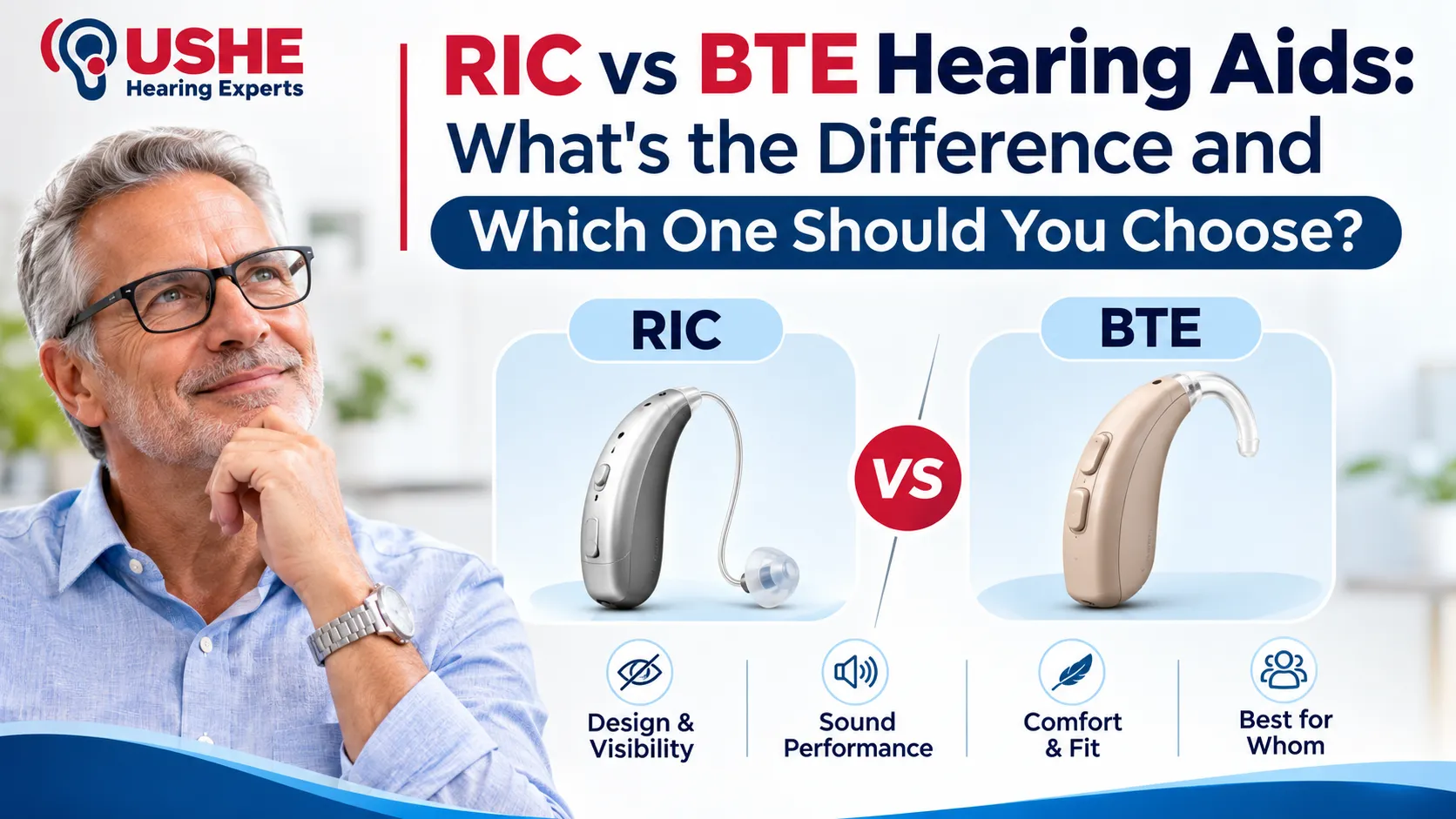
Both RIC and BTE hearing aids sit behind your ear. A RIC places the speaker in your ear canal and connects by a thin wire, while a BTE keeps most parts behind the ear and sends sound through a tube to an earpiece. Your hearing test, comfort and budget should decide, not the style alone.
You put your glasses on, then your mask, then your hearing aid, and suddenly the space behind your ear feels crowded. That’s usually when people start asking whether a different style would suit them better. At USA Hearing Experts, our audiologists help people across the USA compare hearing aid styles online, and our guide to hearing aid types covers every style. Here we focus on two of the most popular: RIC and BTE.
Summary
RIC (receiver-in-canal) and BTE (behind-the-ear) hearing aids look similar from the side, but they work and feel different. RIC is smaller and often more discreet, while BTE is sturdier and easier to handle. Listed examples run from $499 to $2,960, and style doesn’t set the price on its own.
Key Takeaways
- RIC puts the speaker in the ear canal, while BTE keeps it behind the ear.
- RIC is typically smaller, and BTE is typically easier to handle.
- Both styles come in power models, so your audiogram decides.
- Listed examples run from $499 to $2,960 and aren’t labeled per ear or per pair.
- Features like Bluetooth and rechargeability depend on the model, not the style.
- A professional hearing test should come before any purchase.
What Is the Difference Between RIC and BTE Hearing Aids?
The main difference is where the speaker sits. In a RIC the speaker (receiver) is in your ear canal, and in a BTE it’s inside the case behind your ear.
| Feature | RIC (receiver-in-canal) | BTE (behind-the-ear) |
|---|---|---|
| Speaker location | In the ear canal | Behind the ear |
| Connection to the ear | Thin wire | Tube to an earmold or earpiece |
| Size | Typically smaller | Typically larger |
| Handling | Smaller parts | Easier to clean and handle |
| Worth weighing | The part in your canal needs regular care | More visible behind the ear |
You may also see RIC called RITE (receiver-in-the-ear), and the two terms mean the same thing.
What Is a BTE Hearing Aid?
A BTE hearing aid keeps most of its parts in a small case behind your ear. According to the FDA, that case connects to an earmold or earpiece by clear tubing, and BTE hearing aids are easy to clean and handle and relatively sturdy.
That sturdiness is why many people choose BTE for everyday durability. Larger cases can also hold bigger controls and batteries, so many power models are BTE.
What Is a RIC Hearing Aid?
A RIC is a smaller type of BTE. The FDA notes that its earpiece may reduce the plugged-up feeling called the occlusion effect, increase comfort, reduce feedback and address cosmetic concerns for many users.
A thin wire runs from the case behind your ear to a receiver in the ear canal. ASHA describes the device as hooking over the top of the ear and resting behind it with that thin wire.
Which Is Better for Your Hearing Loss: RIC or BTE?
Neither is better for everyone, because both come in different power levels. Your audiogram shows how much amplification you need, and that guides the choice.
Don’t assume RIC is only for mild loss or BTE only for severe loss. Both styles include power models, so share your hearing test report with our audiologists before you decide. We can’t diagnose hearing loss online, so start with a professional test.
Which Is More Comfortable and Discreet?
RIC often feels lighter and less noticeable. BTE can feel more secure, especially if you wear glasses, a hat or a helmet.
Comfort is personal, and ear shape matters too. ASHA lists ear canal shape and size among the factors that affect which device works for you, along with ease of insertion and handling.
Which Is Easier to Handle if Your Fingers Aren’t Steady?
BTE usually wins here. The FDA says BTE aids are easy to clean and handle, and larger controls on some models can help.
RIC parts are smaller, but many people manage them well after a little practice. If dexterity worries you, tell us, and we’ll point you toward models with easier controls.
How Much Do RIC and BTE Hearing Aids Cost at USA Hearing Experts?
Style doesn’t set the price, so RIC and BTE ranges overlap widely. The examples below are listed prices in U.S. dollars, and they aren’t labeled per ear or per pair.
| Style | Model we list | Listed price (USD) |
|---|---|---|
| BTE | Oticon Jet 2 Power PLUS BTE | $499 to $849 |
| BTE | Oticon Xceed 1 Ultra Power BTE | $1,099 to $2,149 |
| BTE | Oticon Alta 1 Pro Mini BTE | $1,480 to $2,960 |
| RIC | Oticon Jet PX 2 miniRITE Power | $849 to $1,399 |
| RIC | Oticon Intent 4 miniRITE Power | $1,299 to $2,199 |
| RIC | Oticon Intent 3 miniRITE Power | $1,399 to $2,499 |
At checkout you choose left, right or both, so please confirm your total with our team before you order. Browse the full RIC collection to see every RIC model.
You can also see every BTE hearing aid we list. These tables show examples, not every model.
Do RIC and BTE Hearing Aids Both Have Bluetooth and Rechargeable Batteries?
Many do, but it depends on the model, not the style. Some RIC and BTE models are rechargeable and stream calls from your phone, while others use disposable batteries.
Check the product details for the exact model, or ask us. Hearing aids make sound more usable, but they don’t restore normal hearing.
How Do You Choose Between RIC and BTE?
Start with your hearing test, then your daily life, then your budget. Use these quick questions to narrow it down:
- Do you want the smallest look? RIC is usually the better fit.
- Do you want easy handling and sturdiness? BTE may suit you.
- Do you wear glasses, hats or helmets daily? Tell us, and we’ll talk through which shape sits better.
- Do you need a lot of power? Both styles offer power models, so ask us about yours.
Can You Buy RIC and BTE Hearing Aids Online?
Yes. You share your hearing test report, talk with our audiologists in an online consultation, and we guide the choice of model. Shipping within the U.S. is free, and most standard devices can be returned or exchanged within 30 days of delivery, though custom devices are excluded and a restocking fee may apply.
Conclusion
RIC and BTE hearing aids both sit behind your ear, but they differ in where the speaker sits, how they feel and how easy they are to handle. RIC tends to be smaller and more discreet, while BTE tends to be sturdier and simpler to clean. Price depends on the model and level rather than the style, so confirm per-ear or per-pair pricing before you buy. Send us your hearing test report, and we’ll help you choose the style that fits your hearing, your routine and your budget.
Ready to Choose Your Hearing Aid Style?
Call (469) 432-4011, email support@usahearingexperts.com, or book an online consultation with our audiologists. Share your hearing test report, and we’ll help you compare RIC and BTE options.
Frequently Asked Questions
What is the difference between RIC and BTE hearing aids?
A RIC puts the speaker in your ear canal and connects by a thin wire. A BTE keeps most parts behind the ear and sends sound through a tube to an earmold or earpiece.
Which is better, RIC or BTE hearing aids?
Neither is better for everyone. RIC is typically smaller, BTE is typically easier to handle, and your hearing test should guide the choice.
Are RIC hearing aids more expensive than BTE?
Not by style alone. At USA Hearing Experts, listed examples run from $499 to $2,960 across both styles, and prices aren’t labeled per ear or per pair.
Is RIC the same as RITE?
Yes. RITE stands for receiver-in-the-ear, and it’s another name for RIC.
Can I buy RIC or BTE hearing aids online?
Yes. You can order after sharing your hearing test report and talking with our audiologists. Standard devices can be returned or exchanged within 30 days, and custom devices are excluded.